AI Product Management Certification Toronto

Earn the AI Product Manager Certification (PMC™)
Equip your teams to build better products faster by leveraging AI at every stage of the product lifecycle. Go from product discovery to launch, while gaining hands-on roadmapping, AI-assisted prototyping, and data-driven decision-making skills taught by leading product practitioners.
Get Started
Get in touch with our team to discuss training details and reserve a date.
Upcoming Training
Reserve an Upcoming Date
Flexible, In-Person Training
482 Front St W, 2nd Floor, Toronto, ON
- Sep2026Closed
- Oct2026Limited Dates
- Nov2026Now Reserving
- Dec2026Now Reserving
40k+ professionals trained
4.7 on Google
Learn from experts

Course Overview AI Product Management Certification

Maxime
Launch Engineer, Shopify Plus at Shopify

Khaled
Senior Product Manager at Amazon


BrainStation helped me better understand product, marketing, entrepreneurship. And all of those different skills led me to Shopify.
Maxime
Product Management at Shopify
Get Certified as an AI Product Manager
Gain essential Product Manager skills with hands-on instruction from industry leaders working at the best global tech companies like Amazon, Meta, and Microsoft.
AI Product Manager Certification (PMC™) Course Overview
PMC-2026Q4Product Development Lifecycle (PDLC)
Product Discovery
Opportunity Discovery
Product Strategy
Product Vision
Value Proposition
Product-Market Fit
Customer Research
User Personas
Market Analysis
Artificial Intelligence (AI)
Generative AI
Research Synthesis
Minimum Viable Product (MVP)
Product Requirements Documents (PRDs)
Product Roadmaps
Product Prioritization
Stakeholder Collaboration
Agile Product Development
Scrum
Sprint Planning
Wireframing
Rapid Prototyping
Usability Testing
Go-to-Market (GTM) Strategy
Product Analytics
Key Performance Indicators (KPIs)
Validation & Iteration
Lean Product Development
Agile Methodology
Scrum Framework
Kanban
Jobs-To-Be-Done (JTBD)
Kano Model
Root Cause Analysis
How Might We Statements
Objectives & Key Results (OKRs)
Product Development Process
Stakeholder Communication Framework
Lean Analytics
Risk Assessment Framework
- Gemini
- Claude
- ChatGPT
- Copilot
- Perplexity
- NotebookLM
- Figma Make
- Jira
- Canva


Why Get Certified as a Product Manager
Taught By Leaders From Top Global Tech Companies
Receive hands-on training from product management leaders working at companies like Amazon, Meta, and Microsoft.
Build Your Product Management Portfolio
Build a product management portfolio that demonstrates your unique expertise and experience.
Globally Recognized By Top Companies
BrainStation certifications are globally recognized by top companies for the most advanced and up-to-date skills.
Product Manager Success Stories
The program included a final product presentation reviewed through detailed instructor assessments. Its structured and in-depth curriculum, combined with high-quality feedback, created a learning experience that was focused, practical, engaging and outcome-driven.
Derya Aydın
Principal Technical Program Manager at Microsoft




Miguel Gentile
VP of Product at PolicyMe

Palwasha Ghani
Lead Digital Product Owner at RBC Insurance

Strachan Gould
Senior Product Manager at Bumble Inc.

Reza Hussain
Senior Manager, Product Management at Lowe’s

Bianca Kamper
Senior Digital Product Manager at Red Bull Media House

Brit Mackey
Product Designer, Growth at Zapier

Zoya-Aleah Abrams
Digital Product Manager at BMO

Yara Abuhudra
Innovation Project Manager at DHL

Udeaku Adekunle
Senior Manager (Product) at Visa

Elias Adum
Staff Software Engineer at Shopify

Himanshu Aggarwal
Director at Sun Life

Saayed Agha
Manager, Industrial Engineering at Walmart

Heba Ahmed
Senior Product Manager at PwC

Katherine Radojewski
Implementation Specialist at SurveyMonkey


















AI Product Management Course Curriculum
- Unit 1
Product Discovery & Strategy
Explore the end-to-end Product Development Lifecycle (PDLC) and learn how Product Managers guide products from concept to market. Through real-world product case studies, build the foundational product management skills enabling you to identify the right opportunities and align your team on a clear product vision. Use AI to accelerate discovery activities including customer and market research, along with user interview synthesis and analysis as you work towards refining your strategy.
- Gemini
- Claude
- ChatGPT
- Copilot
- Perplexity
- NotebookLM
- Key skills:
- Product Development Lifecycle (PDLC)Product DiscoveryOpportunity DiscoveryCustomer ResearchProduct StrategyMarket AnalysisCompetitive AnalysisProduct ThinkingStakeholder CommunicationAI-Assisted Product Workflows
Conduct Customer Discovery and Market Research
Learn how a Certified AI Product Manager performs effective customer research, leveraging conversational AI engines to synthesize user feedback at scale. Define your target customers as rich user personas to inform your customer-centric strategy.
Problem Space vs Solution Space
Learn to separate the problem you're solving from the solution you're building: a distinction that shapes every downstream product decision. Apply structured frameworks and AI-assisted analysis to evaluate opportunities and move into the solution space with confidence.
Define the Product Vision and Strategy
Translate your research and customer insights into a product vision and strategy that connects customer needs to business goals. Learn to set a clear product direction and align your team around what to build.
- Unit 2
Product Planning & Agile Execution
Move from identifying opportunities to defining and executing on solutions. Discover how Agile and Lean methodologies work in tandem to enable cross-functional product teams to move quickly and iterate toward product-market fit. Learn how a Certified AI Product Manager collaborates with engineering teams while leveraging AI to accelerate planning, prioritization, and documentation at every step.
- Gemini
- Claude
- ChatGPT
- Copilot
- JIRA
- Key skills:
- MVP DefinitionProduct Requirements Documents (PRDs)Product RoadmappingProduct PrioritizationOKRs & KPIsAgile Product DevelopmentSprint PlanningStakeholder CollaborationCross-Functional CommunicationAI-Assisted Product PlanningScrum Frameworks
Define Product Solutions & MVPs
Learn how Product Managers apply the build-measure-learn Lean framework to scope efficient Minimum Viable Products (MVPs). Explore how AI can let you rapidly test hypotheses and iterate toward an MVP.
Create PRDs & Roadmaps
Develop practical skills writing PRDs with AI, prioritizing features, and understanding how product roadmaps align teams, communicate product direction, and guide product development over time.
- Unit 3
AI-Powered Prototyping, Testing & Validation
Move from planning to building by turning product requirements into wireframes, user flows, and prototypes. Leverage iterative product development processes to validate product decisions and learn how AI Product Managers work cross-functionally with design and engineering to bring ideas to execution. Explore how AI is transforming the prototyping process, helping product teams move from concept to testable prototype faster.
- Gemini
- Claude
- ChatGPT
- Copilot
- Figma Make
- Key skills:
- Rapid PrototypingWireframingUser FlowsUser TestingCross-Functional CollaborationIterative Product Development
Rapid Prototyping with AI
Explore how AI tools can accelerate product prototyping by generating wireframes, prototypes, interface concepts, user flows, and early-stage product ideas.
Test & Validate Product Ideas
Learn how product teams gather user feedback, validate assumptions, and evaluate product experiences through testing and iteration. Explore how validation helps reduce risk and improve product decisions.
Design & Engineering Collaboration
Explore how AI Product Managers work cross-functionally with designers and engineers to communicate product requirements, align priorities, and support product execution.
- Unit 4
Go-to-Market Strategy & Product Analytics
Complete the Product Development Lifecycle (PDLC) by learning how AI Product Managers develop go-to-market (GTM) strategies that connect product positioning, customer needs, marketing, and business goals, supported by modern AI tools. Build the product analytics skills to measure adoption, engagement, and business impact after launch, and use performance data to guide future decisions.
- Gemini
- Claude
- ChatGPT
- Copilot
- Canva
- Key skills:
- Go-to-Market (GTM) StrategyProduct PositioningProduct Launch PlanningStakeholder AlignmentProduct AnalyticsKPIs & Success MetricsProduct Performance ReportingData-Driven Product DecisionsAI-Assisted Product Analytics
Develop a Go-to-Market Strategy
Learn how Product Managers plan and support successful product launches by aligning positioning, target audiences, messaging, and business goals. Explore the key components of an effective GTM strategy.
Measure Product Success
Discover how product teams track product performance using KPIs, analytics, and customer feedback. Learn how Product Managers evaluate adoption, engagement, and business impact to guide future product decisions.
Leverage AI Tools for Product Analytics
Explore how AI tools can support product workflows by analyzing feedback, identifying trends, generating insights, and accelerating product reporting and decision-making.


Earn Your AI Product Manager Certification (PMC™)
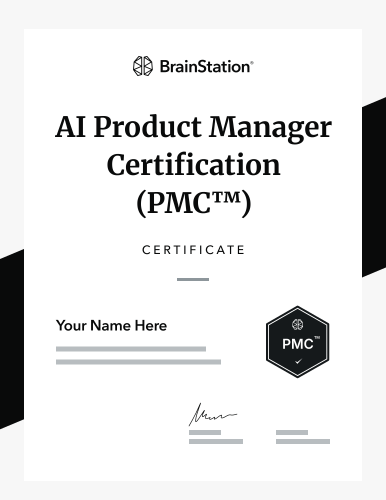
Successfully completing BrainStation's AI Product Management Certification course will earn you the globally recognized BrainStation AI Product Manager Certification (PMC™), demonstrating your mastery of the latest cutting-edge skills and tools. Add this credential to your LinkedIn profile and resume or CV.


Get Certified in AI Product Management
Talk to our team to get started.
Get Started
Get in touch with our team to discuss training details and reserve a date.
Join BrainStation's Global Alumni Network
With a BrainStation Certification, you'll join our global alumni network: a community of accomplished professionals with BrainStation Certifications across a range of critical tech skills, including Product Management.
40,000+
Global BrainStation Alumni
100+
Countries

Industry-Led Product Management Certification
BrainStation's globally recognized certifications are created by industry professionals, for industry professionals. Our network of experts from leading tech companies provide insights and guidance to ensure each certification demonstrates the latest cutting-edge skills and tools.








Welcome to
BrainStation Toronto
at The Well
Learn in the Center of Toronto's Tech Hub
Located in the heart of Toronto's Tech Alley, BrainStation is at the center of Toronto's tech scene, surrounded by the best tech companies in Toronto. In addition to courses, BrainStation Toronto offers training sessions, industry events, expert panel discussions, and more.
BrainStation Toronto
482 Front St W, 2nd Floor, Toronto, ON


Frequently Asked Questions
This course teaches foundational, industry-standard Product Management, but with a massive competitive edge: you will learn to use AI tools at every stage of the product lifecycle. Instead of relying on manual workflows alone, you will use generative AI and automation to conduct market research, synthesize user feedback, write PRDs, and build roadmaps in a fraction of the time.
Not at all. You do not need any coding, engineering, or data science experience. This course is about Product Management methodology, not building AI models. You will learn how to use existing AI tools to strengthen your strategic thinking, writing, and analytical work as a PM.
You will integrate AI tools into the core pillars of PM work:
- DiscoveryUse conversational AI to synthesize customer and market research and user interviews at scale, extracting key insights and pain points.
- StrategyUse AI-assisted analysis to evaluate opportunities and shape a product vision and strategy that connects customer needs to business goals.
- DefinitionUse AI to write PRDs, scope MVPs, and prioritize features into a clear roadmap.
- OptimizationUse AI-driven product analytics to measure performance and surface trends and insights from KPIs and customer feedback to guide decisions.
You will get hands-on experience with leading generative AI tools, including ChatGPT, Claude, Gemini, Copilot, and Perplexity, alongside product tools such as Figma Make for prototyping and Jira for product workflows.
Yes, an AI tool is only as good as the PM directing it. You will learn core PM methodologies in depth: Agile/Scrum frameworks, user-centric design principles, KPI mapping, feature prioritization frameworks, and stakeholder management. AI is taught as an accelerator for these fundamentals, not a replacement for them.
You will develop an end-to-end product launch strategy for a digital product from scratch. Using AI tools to assist your workflow, you will produce a validated product concept, a product roadmap, an MVP prototype, and a go-to-market strategy, presenting your work as a final portfolio project. This portfolio piece shows employers that you can deliver high-quality product management work.
It's ideal for both. For aspiring Product Managers or career switchers, it teaches PM frameworks the right way for the modern job market, giving you an advantage over those using outdated and inefficient processes. For current PMs, business analysts, or project managers, it's an effective upskilling program to help you work more effectively and stay competitive in an AI-driven workforce.
Classes are taught live by active Product Leaders from top tech companies (like Amazon, Meta, and Microsoft). These are practitioners who actively use AI tools in their daily roles to manage teams, scale products, and streamline their workflows, so you get practical, real-world insights.
The course is a part-time, 8-week program designed for working professionals. It requires 3 hours of live instruction per week, which you will attend in person at one of our locations in either New York, Toronto, or London, or entirely live online. Students typically spend an additional 2 to 4 hours per week applying what they've learned to their hands-on PM portfolio project.
Traditional PM courses teach workflows from five years ago. In today's market, employers want PMs who know how to work smart and fast. By learning how to leverage AI as a product lifecycle assistant, you learn how to condense days of competitive research and document drafting into hours, making you an incredibly efficient and attractive PM.
Absolutely. Because this course directly focuses on increasing operational efficiency and productivity using modern tools, it qualifies for most corporate Learning & Development budgets. We provide an Employer Sponsorship Package complete with a syllabus breakdown and an expense justification letter to help you pitch the ROI of this course to your manager.
When you enroll, you join a global network of over 40,000 BrainStation certified professionals. At our New York, Toronto, and London locations, you'll have access to networking mixers, industry panel events, and collaborative workspaces, and all learners gain access to our community Slack, where you can connect with peers and instructors and stay in touch after the course ends.
The AI Product Manager Certification (PMC™) is a globally recognized credential. BrainStation has been a leader in digital skills training since 2012 and has certified over 40,000 professionals globally. Adding this certification to your resume and LinkedIn signals to recruiters that you possess modern, validated product skills.
Don't worry: flexibility is built into the program. If you need to miss a session, our team will help make sure you're able to catch up with your cohort. Sessions are live, interactive, and hands-on, so it's important to make class attendance a priority.
We want to make upskilling accessible. We offer flexible payment options, including payment plans and partial scholarship opportunities, subject to eligibility. A Learning Advisor can help find the option that works best for you.
Product Management 101
Will a Product Management certification help my career path?
A Product Management certification supports career growth by validating expertise, demonstrating commitment, and building a foundation in essential concepts. This credential can make candidates more attractive to employers, especially those transitioning into product management or aiming for senior roles.
Reserve an Upcoming Date
40k+ professionals trained
Learn from experts
Upcoming Training
Flexible, In-Person Skills Development
482 Front St W, 2nd Floor, Toronto, ON
- Sep2026Closed
- Oct2026Limited Dates
- Nov2026Now Reserving
- Dec2026Now Reserving
Get Started
Get in touch with our team to discuss training details and reserve a date.